01
What the National Archives Actually Holds
record groups, the Army and Navy split, where the reels physically are, and what is not there at all.
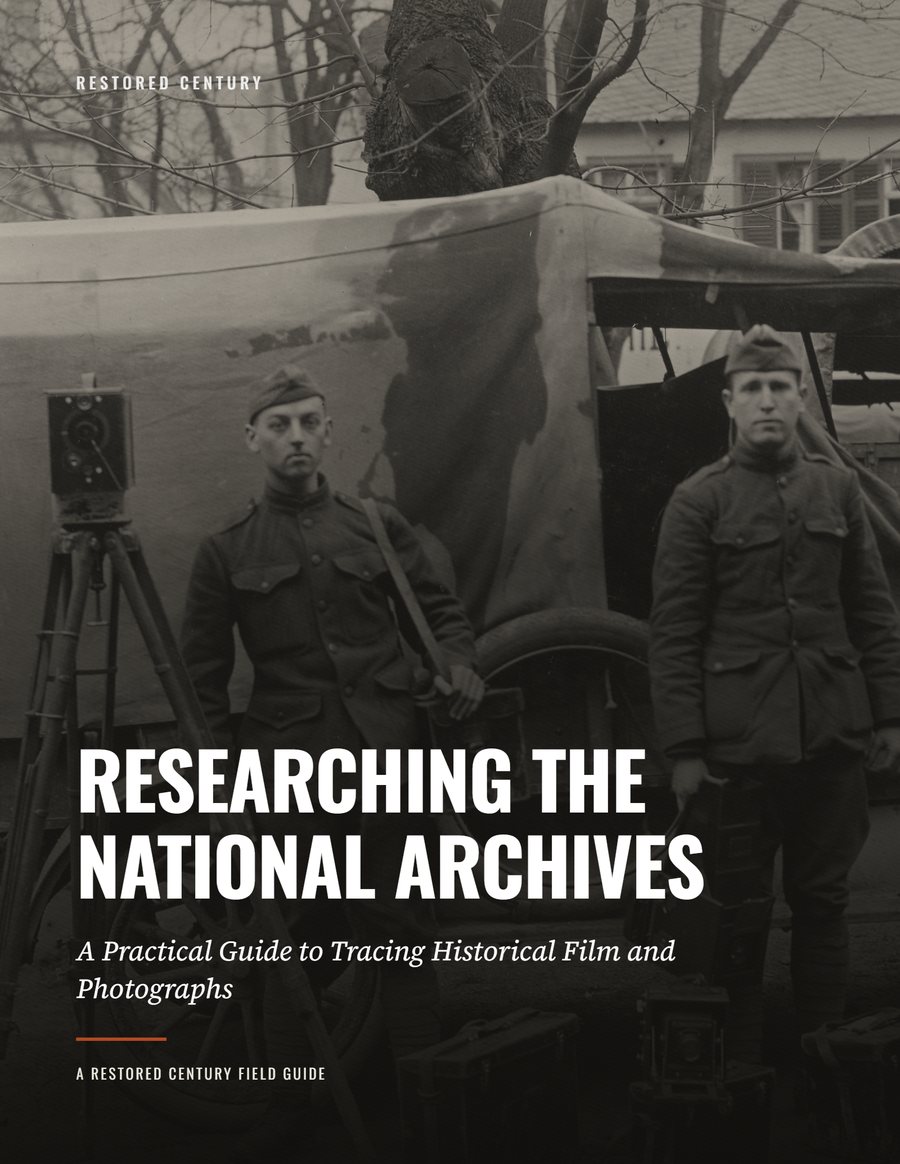
A Practical Guide to Tracing Historical Film and Photographs
You hear it in every documentary: "according to the National Archives." This guide shows you how to find the record behind the footage yourself, read it like a researcher, date it, test its claims, and get your own copy, often free and in full resolution.
Downloadable PDF ebook · 113 pages · 4 printable worksheets
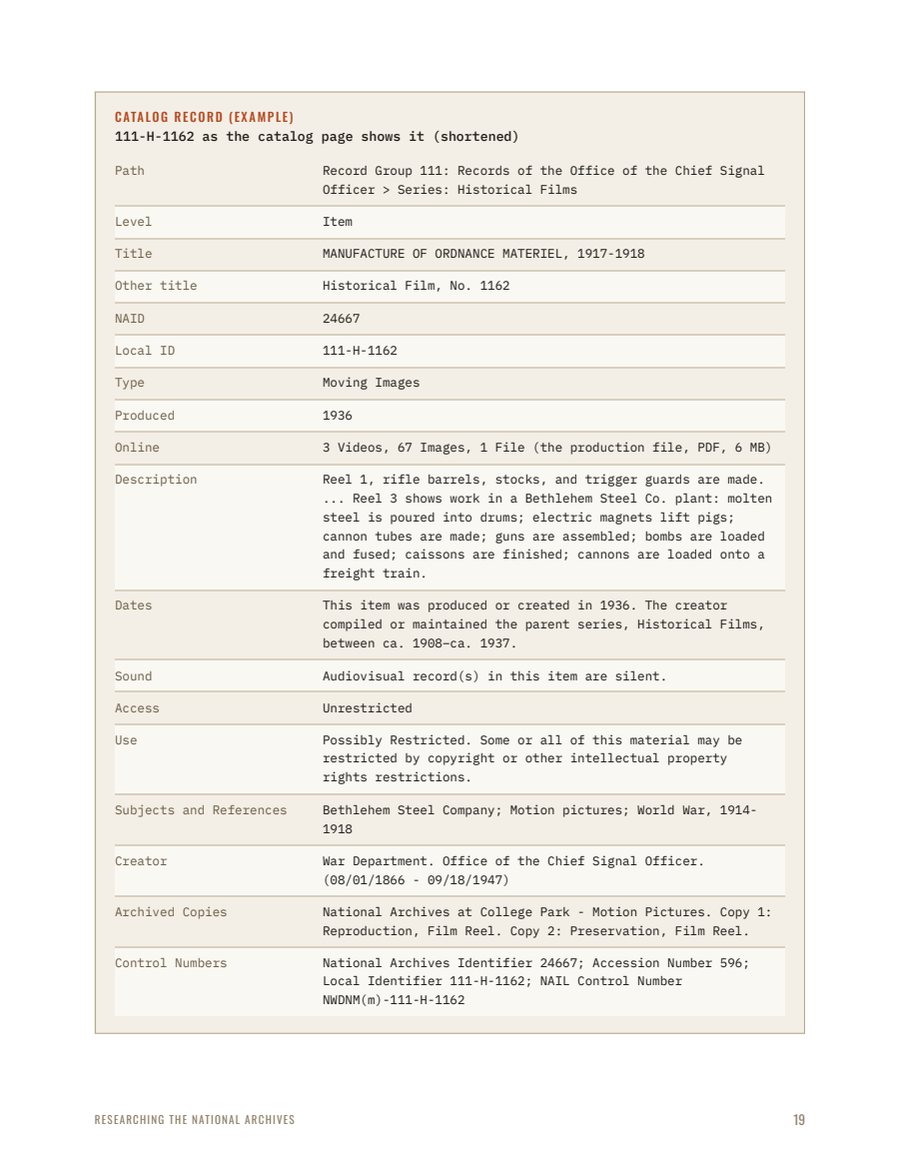
A Signal Corps film in the National Archives Catalog is titled Manufacture of Ordnance Materiel, 1917-1918. Its production date says 1936.
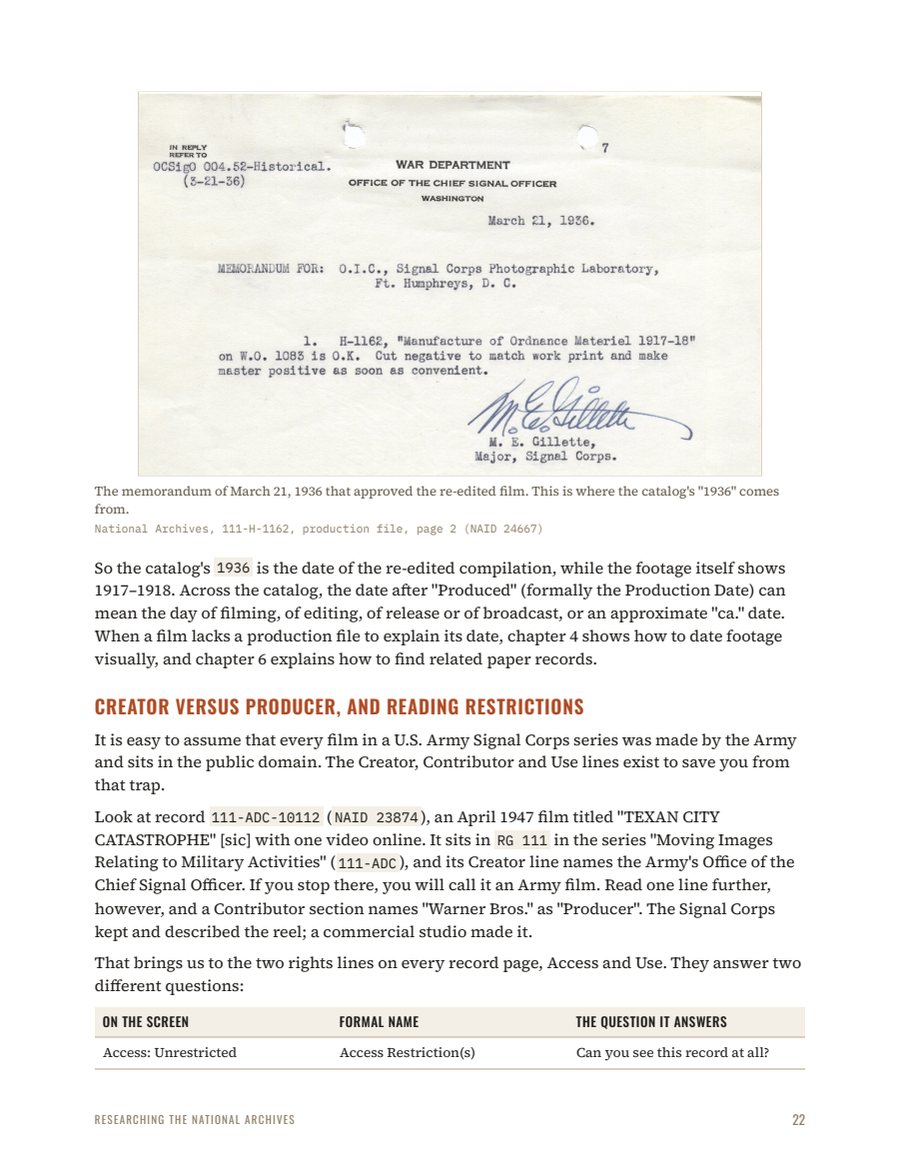
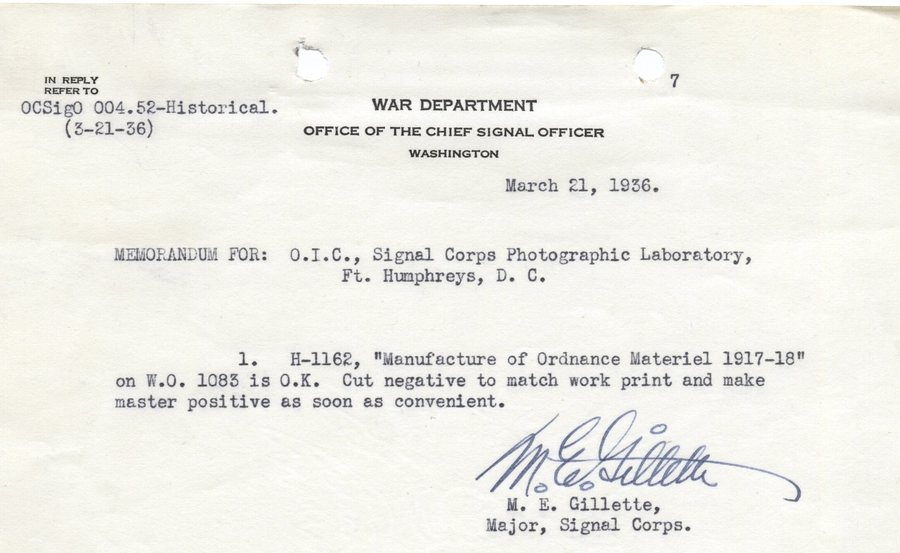
A typo? No. Attached to the catalog record is the film's 67-page production file, and on page two sits the answer: a War Department memo dated March 21, 1936, approving a re-edited version cut from older footage. The camera work shows the war. The reel you can watch today was assembled eighteen years later.
That is what this guide teaches. The record behind a film is a document too, and it often says something the film does not. Once you know where to look, "according to the National Archives" stops being a phrase you take on trust and becomes something you can check.
111-H-1162.record groups, the Army and Navy split, where the reels physically are, and what is not there at all.
every field, what each date means, whose words you are reading, and what the restrictions say.
search syntax, filters, and the series notes and card indexes most people never open.
film stock and edge codes, insignia, flags and helmets, and the editorial layer.
re-created battles, staged scenes, and the captions that sold them.
production files, caption cards, release sheets and shot cards: the film's paper twin.
how photographs are described differently, and the series to search first.
free downloads, research room visits, ordering film copies, and what you may reuse.
four of our own investigations, start to finish.
logs, citations and evidence grades that hold up when someone checks.
Plus: a record group quick reference, four printable worksheets, a glossary, and every official link in one place.
Every catalog entry in the book is a real one, printed with its identifier, so you can open it and check it yourself.
The facts were checked against the National Archives Catalog and NARA's own web pages in October 2026, and every chapter lists its sources.
You need a computer, the free online catalog and some patience. No degree, no membership, no trip to Maryland, although the book tells you how to make one.
"Public domain" is often true and sometimes not. The book shows you how to read the rights notes on each record, and where the traps are.
Written by Restored Century. It is not a National Archives publication and is not endorsed by NARA.
113 pages as one PDF. Reads on any phone, tablet or computer; print the pages you want.
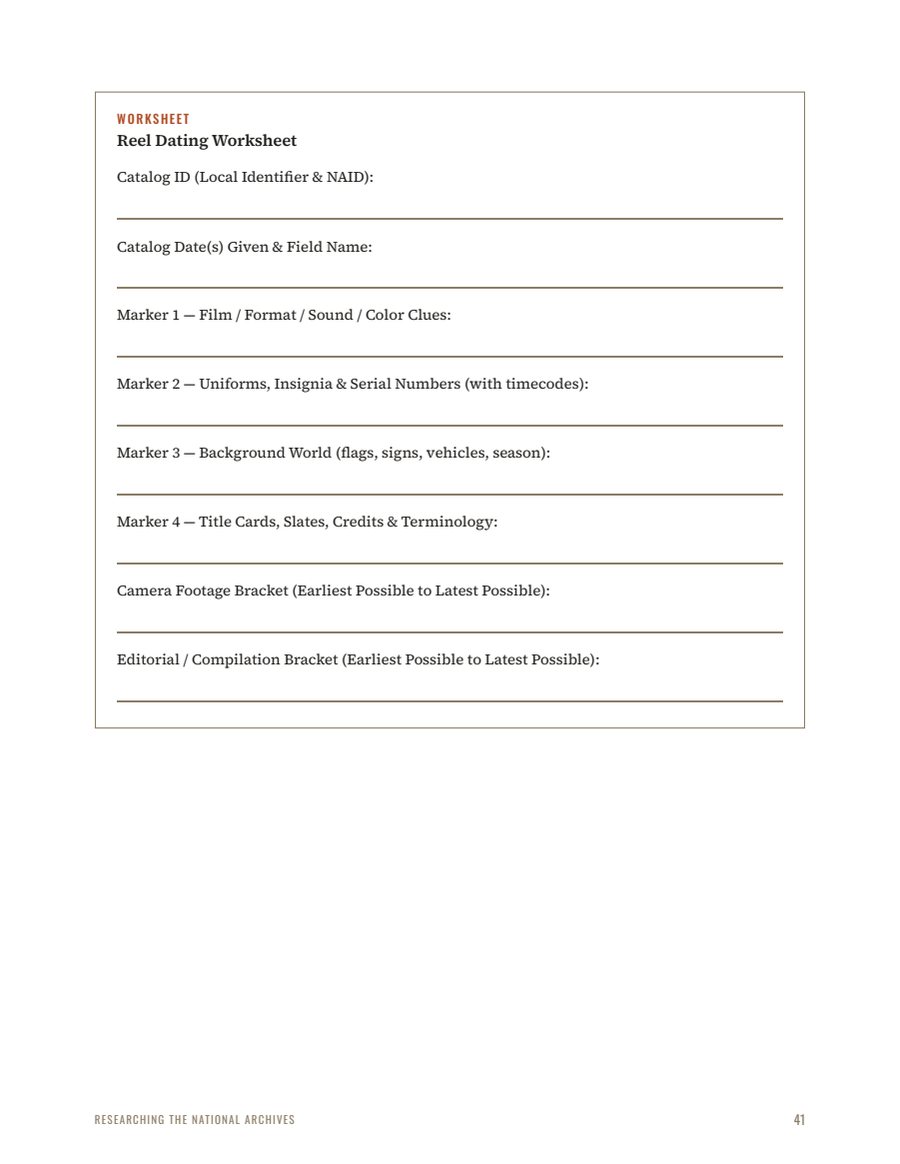
research log, reel dating sheet, claim ledger and reproduction request, ready to print.
a record group quick reference, a glossary of the archive's words, and every official link, clickable.
launch price until November 12, then $47 · one payment · instant download
Get the ebook — $29One email with your download link and one PDF file. Open it on your phone, tablet or computer, or print the worksheets. Your receipt lets you download it again any time.
Download the guide and read every page. If it isn't what you hoped, reply to your receipt email within 30 days and you'll get every cent back.
Restored Century is a YouTube channel that restores archival film, much of it shot by U.S. Army Signal Corps and Navy cameramen a century ago, and tells what it shows. Behind our episodes is the same groundwork: finding the film's catalog record and the paper trail behind the reel.
This guide is that method, written down for anyone who has ever watched an old film and wondered where it came from.
Watch the channel →No. It's a downloadable ebook: a PDF you can read on any phone, tablet or computer, and print if you like. Nothing is posted, so there's nothing to wait for.
No. It's an independent guide by Restored Century. The National Archives did not produce, review or endorse it.
No. Most of the book works from your desk with the free online catalog. Chapter 8 explains research room visits for when you want to go further.
Yes. The book assumes you have never opened the catalog, and it walks you through your first search in fifteen minutes.
Very likely. Film and photographs work differently from census and military service records: dating reels, production files, caption cards and reuse rights are a craft of their own.
Often, yes: works of the U.S. Government are generally not protected by copyright. Donated and commercial material can be, and the book shows you how to read each record's rights notes. It isn't legal advice.
Yes. Chapter 7 is about still photographs, and the quick reference covers both film and photo series.
The PDF opens in the Kindle apps and on most e-readers, but it reads best on a tablet or computer, where the tables and pictures have room.
Thirty days, no questions asked. Just reply to your receipt email.
Of course. The films on the channel stay free. Watching is support enough.
The record behind the footage is waiting in the catalog, with its dates, its makers and its paper trail. This guide shows you how to find it, read it and keep it.